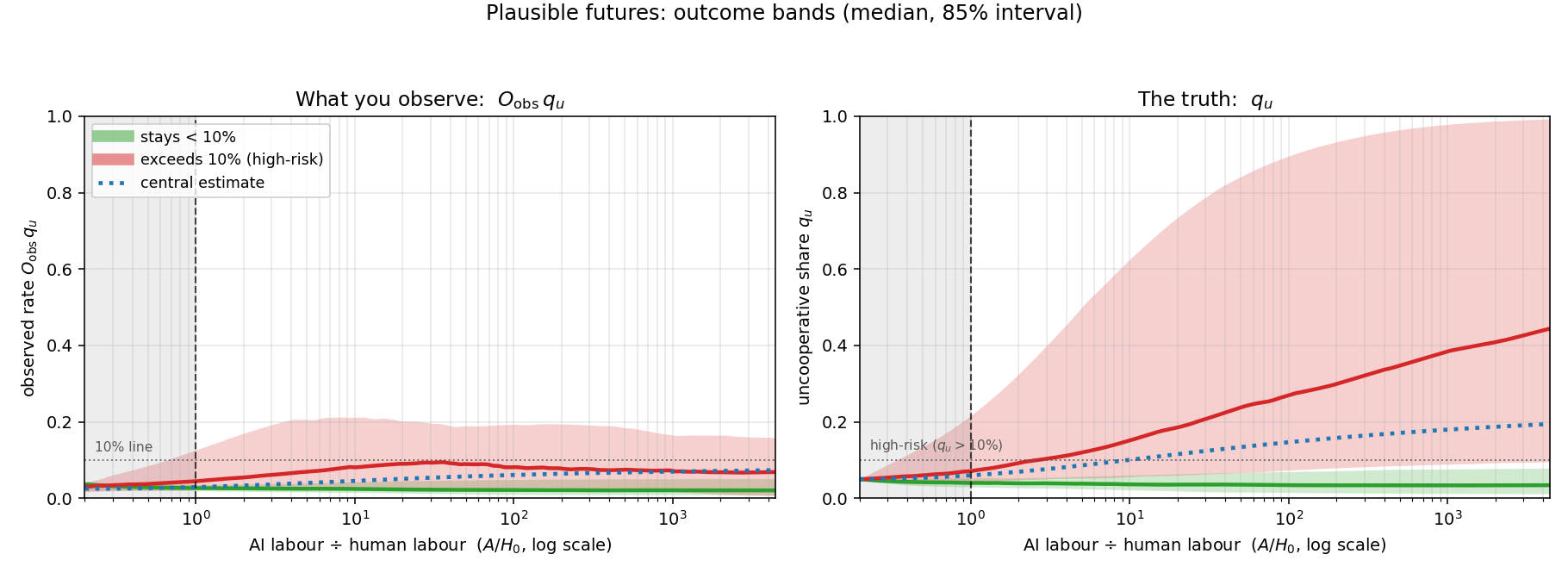
Our model makes predictions, but if we want to have impact there are technical and social
challenges to overcome: better measuring and projecting key parameters, and building
credibility with the communities who need to consider takeover risks. What's the payoff from
addressing them?
Consensus
Alignment on settled questions, calibrated uncertainty on unsettled ones
Disagreements often stall on duelling intuitions — advanced AI will be better at defeating
safeguards, but will also help build better safeguards; we can learn from experience, but
scheming models will deny us that experience. An explicit model does two things here: first,
it pushes discussion towards specific parameters (and mechanisms) with existing
operationalisations and estimates. Focusing on smaller questions raises the likelihood of
resolution, and asks for better estimates in place of vague counter-intuitions. Secondly, it
maps every estimate to an outcome, so duelling intuitions produce concrete differences (or
lack thereof) in projected outcomes.
Evidence
A place to put the news
Every month brings a fresh report of scheming, sandbagging, or reward-gaming. Some get large
reactions, some don't. Careful observers are often cautious about drawing conclusions. Are
these signals truly alarming, or consistent with a healthy development programme? A model can
continually ingest fresh evidence, update parameters and deliver impact estimates.
Interventions
A first-pass policy impact analysis
Scale up safety investment d/acc-style, slow down and reflect, stay laissez-faire, lean on
liability — today these are compared by intuition. These can be parametrised and their impact
estimated, in relation to other interventions and in relation to the estimated task of
delivering good outcomes with high confidence. Even simple models can separate the levers
that move the outcome from the ones that don't.
Regulatory targets
An instrument you could steer by
How do we know if our policy approach can handle danger signals before it's too late? We can
model that too, and give concrete guidance for what we need to achieve for robustness. That's
the
early-warning proposal.